Can AI Save the Global Debt Crisis — or Will Poor Countries Pay the Price?
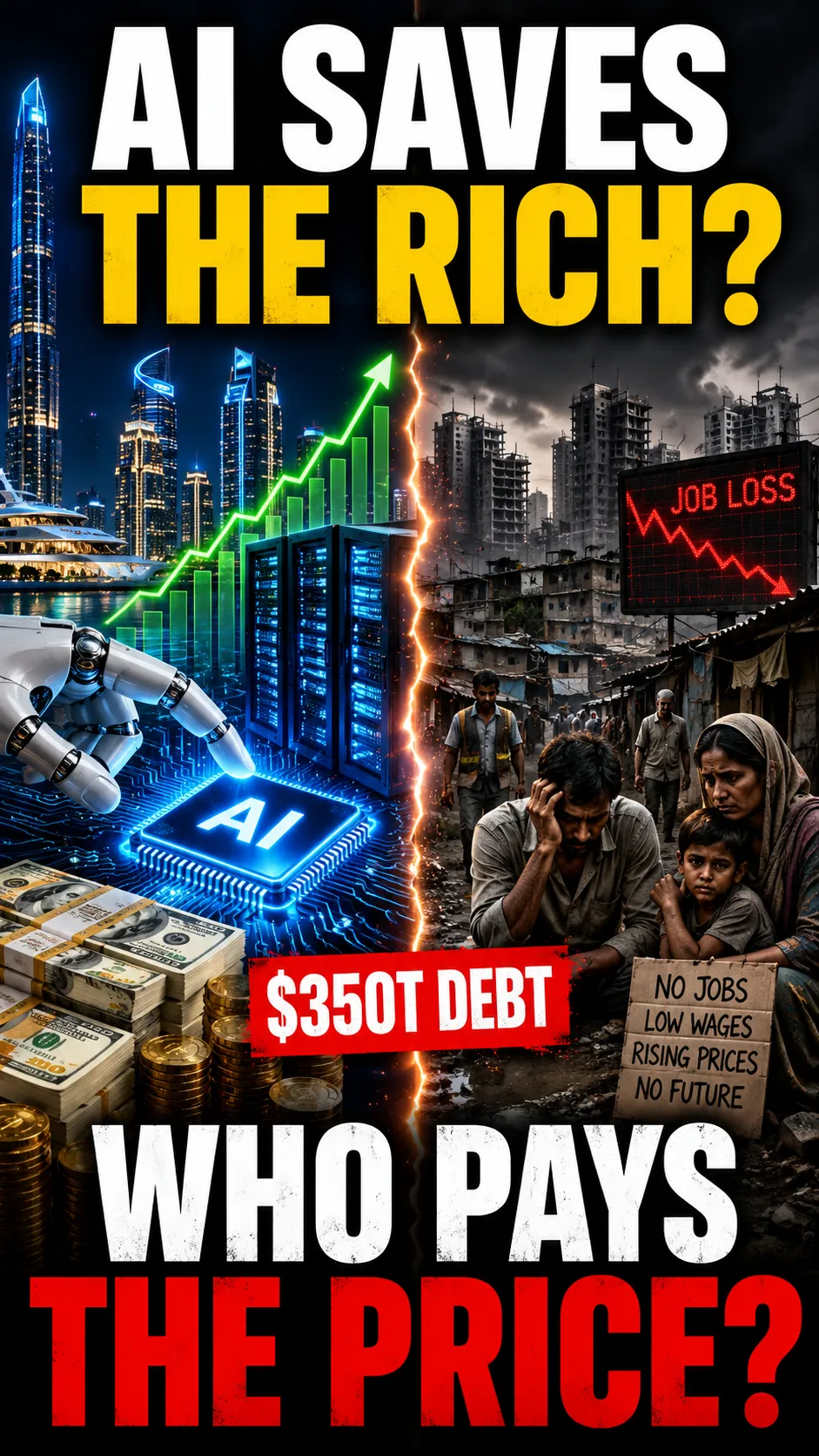 The world is entering a strange new economic era.
On one side, global debt has climbed to a record level, reaching nearly $353 trillion by the end of March 2026, according to Reuters reporting on data from the Institute of International Finance. That debt includes governments, companies, and households across the world.
On the other side, artificial intelligence is advancing faster than almost anyone expected.
Don't miss out

AI can now write code, answer customer questions, analyze documents, generate marketing content, automate office work, and assist in financial research. What used to require teams of workers can now be done by one person using AI tools — or, in some cases, by AI agents working almost independently.
This has created a powerful new hope among economists and policymakers:
What if AI creates a massive productivity boom?
What if AI helps companies produce more with fewer costs? What if GDP rises faster? What if tax revenue grows? What if governments can slowly reduce the pressure of their debt?
At first, it sounds like a miracle.
But there is a darker side to this story.
Because the same AI boom that could help rich countries solve part of their debt problem could also hurt developing countries that depend on outsourcing jobs.
The AI Productivity Dream
The theory is simple.
If AI helps workers become more productive, companies can produce more goods and services. If companies grow faster, economies expand. If economies expand, governments collect more tax revenue. And if governments collect more tax revenue, they have a better chance of managing their debt.
For developed countries like the United States, Japan, Germany, the United Kingdom, and other advanced economies, AI could become a powerful economic tool.
These countries already have:
strong capital markets
major technology companies
advanced cloud infrastructure
large data centers
high-value industries
skilled workers
stronger access to AI investment
That means they are better positioned to use AI at scale.
In simple terms, rich countries may be able to turn AI into a national productivity engine.
A company that once needed 100 support agents may need fewer people with AI chatbots. A software team that once took six months to build a product may finish faster with coding assistants. A marketing department that once required multiple writers, designers, and analysts may now use AI tools to produce campaigns in days.
This does not mean humans disappear.
But it does mean the cost of many knowledge-based tasks could fall dramatically.
And for debt-heavy developed economies, that is the dream:
more output, more profits, more tax revenue, and less pressure from debt.
The Hidden Problem: Who Gets Replaced?
The problem is that one country’s productivity gain can become another country’s job loss.
For the past few decades, many developing countries have benefited from outsourcing.
Companies in the U.S. and Europe outsourced work to countries where labor costs were lower. This created huge industries in places like India, the Philippines, Vietnam, Indonesia, South Africa, and parts of Latin America.
These industries include:
customer service
data entry
software development
virtual assistance
content moderation
bookkeeping
IT support
call centers
back-office operations
For millions of workers, outsourcing became a path into the global economy.
But AI is now targeting many of these exact tasks.
AI chatbots can handle customer support. AI coding assistants can help smaller engineering teams do more. AI tools can summarize documents, process invoices, write emails, clean data, and generate reports.
The IMF has warned that AI could affect around 40% of jobs globally, with some jobs being replaced and others being complemented by AI.
This is where the global divide becomes serious.
Rich countries may benefit because they own the AI platforms, cloud infrastructure, capital, and enterprise customers.
Developing countries may suffer because they provide much of the labor that AI is now learning to replace.
Why This Could Hurt Developing Nations
The danger is not that every outsourcing job disappears overnight.
That would be too simple.
The real danger is slower and more structural.
Companies may stop hiring as many offshore workers. They may reduce customer service teams. They may use AI to handle first-level support. They may keep only senior workers and automate junior-level tasks.
This creates a difficult situation for developing countries.
Many young workers rely on outsourcing jobs as a bridge into the middle class. These jobs often pay better than local alternatives. They also help workers build English skills, technical skills, and international business experience.
If AI reduces demand for these jobs, developing economies could face:
fewer entry-level opportunities
lower wage growth
weaker foreign income flows
more pressure on young workers
reduced demand for outsourcing companies
slower service-sector growth
This does not mean developing countries cannot benefit from AI.
They can.
But they may need strong digital infrastructure, education systems, AI training, and business adaptation to avoid falling behind.
The IMF has also noted that advanced economies are likely to experience AI’s benefits and risks sooner because of their employment structure, while emerging and developing economies face different challenges around readiness and inequality.
AI May Not Save Everyone Equally
This is the key point:
AI may increase global productivity, but the benefits may not be shared equally.
The countries that own the platforms may win first.
The companies that control data centers may win first.
The investors who fund AI infrastructure may win first.
The workers who know how to use AI may win first.
But workers doing repetitive digital tasks may face the biggest pressure.
That creates a serious question for the global economy:
Will AI reduce debt and increase wealth — or will it simply transfer economic power from labor-rich countries to capital-rich countries?
This is why the AI boom is not just a technology story.
It is a debt story.
It is a labor story.
It is a globalization story.
And it may become one of the biggest economic shifts of the next decade.
The Real Future: AI Will Reward Adaptation
The future is not simply “AI replaces everyone.”
The more realistic future is this:
People who use AI will replace people who do not.
Countries that build AI skills will outperform countries that only provide cheap labor.
Businesses that integrate AI into their workflow will move faster than businesses that ignore it.
Workers who learn how to use AI tools for writing, coding, design, research, marketing, automation, and decision-making will have an advantage.
For developing nations, the solution is not to fight AI.
The solution is to move up the value chain.
Instead of only offering low-cost labor, they need to build AI-powered services, AI-assisted outsourcing, technical education, automation consulting, and specialized digital products.
A customer support worker can become an AI support system manager.
A basic coder can become an AI-assisted software builder.
A virtual assistant can become an automation specialist.
A content writer can become an AI content strategist.
A freelancer can become a one-person AI-powered agency.
The countries and workers that adapt fastest will have the best chance of surviving the transition.
Final Thought
AI may help the world deal with its massive debt problem.
It may increase productivity. It may help companies grow. It may increase tax revenue. It may become the economic engine that governments desperately need.
But there is no free rescue.
If rich countries use AI to replace overseas labor, the cost of this productivity boom may be paid by workers in developing nations.
So the real question is not simply:
Can AI save the global economy?
The better question is:
Who benefits from the AI boom — and who pays the price?
Want more breakdowns on AI, the future of work, and the global economy?
Follow NextTechBit for simple, practical insights on how AI is changing business, jobs, and money.